
Learn more about the Kanary project

AdOps Reporting Dashboard Case Study
One of the most notable and influential changes to the online display-advertising industry over the past decade has been the introduction of real-time bidding (RTB).
This complex process provides many benefits to both marketers and publishers. For marketers in particular, they can target the right audience, expand their reach, better control their marketing budgets, and optimise ROI. Unfortunately, there is a lot of obscurity within the industry, especially regarding the actual cost of impressions. That’s where Kanary comes in.
CLIENT
Enterprise
INDUSTRY
Programmatic advertising
SERVICE
AdTech, MarTech
COUNTRY
United States
About Kanary Nest
Kanary NEST provides advertisers with an easy way to buy display ads by using programmatic and real-time bidding (RTB) technology with fully transparent reporting on media spend, conversions, and commissions.

Key points
Product
Our client wanted to build their own AdTech stack to create a walled garden and monetize their first-party data.
Solution
The AdTech stack consisted of a self-serve ad platform, an ad server, a data lake, and a customer data platform (CDP).
Project goal
The goal of the project was to replace our client’s existing third-party tools to have full control and ownership of their AdTech stack.
Technologies
We built the AdTech stack using a wide range of technologies, including AWS, Python, Go, React, Terraforms, Docker, TypeScript, Django, Bitbucket, and many more.

“They simply build things better than the rest – period.”
Alex Wheldon
Director, Kanary NEST
The Goal
The goal of Kanary was to build a fault-tolerant, scalable demand-side platform (DSP) that optimizes the user experience and provides a clear and interactive user interface that can be operated by even the most novice user.
Main challenges
The main challenges involved developing a platform that could handle billions of bid requests and display the data in real time. In addition to the technical challenges, we also had to address the visual and data presentation aspect, which involves displaying the massive amounts of data in a clear and easy-to-understand way. To overcome this challenge, we had to come up with a user experience and design strategy that would produce a user-friendly interface allowing all users to easily understand their campaigns’ performance.
Building the Kanary platform required a mix of technical solutions coupled with a user-friendly interface and sharp design elements.
After evaluating the current state of the real-time bidding process and identifying challenges and opportunities, we came up with a list of features that would provide clients with the following:
What we did
After carefully defining and planning the scope of the project, we set out to solve the challenges and conquer the project’s goals.
Bid requests
Receiving, handling, and processing bid requests are the core functionalities of the Kanary platform. We designed the system architecture and scaled it horizontally, which enables the platform to handle billions of daily bid requests, while at the same time utilizing limited infrastructure.
Platform performance
We developed the backend of the platform using multiple software development solutions and tools – Python, Twisted, Redis, Storm, and others. This modern and powerful combination enables the platform to maintain ultra-fast performance.
Branding, UX&UI
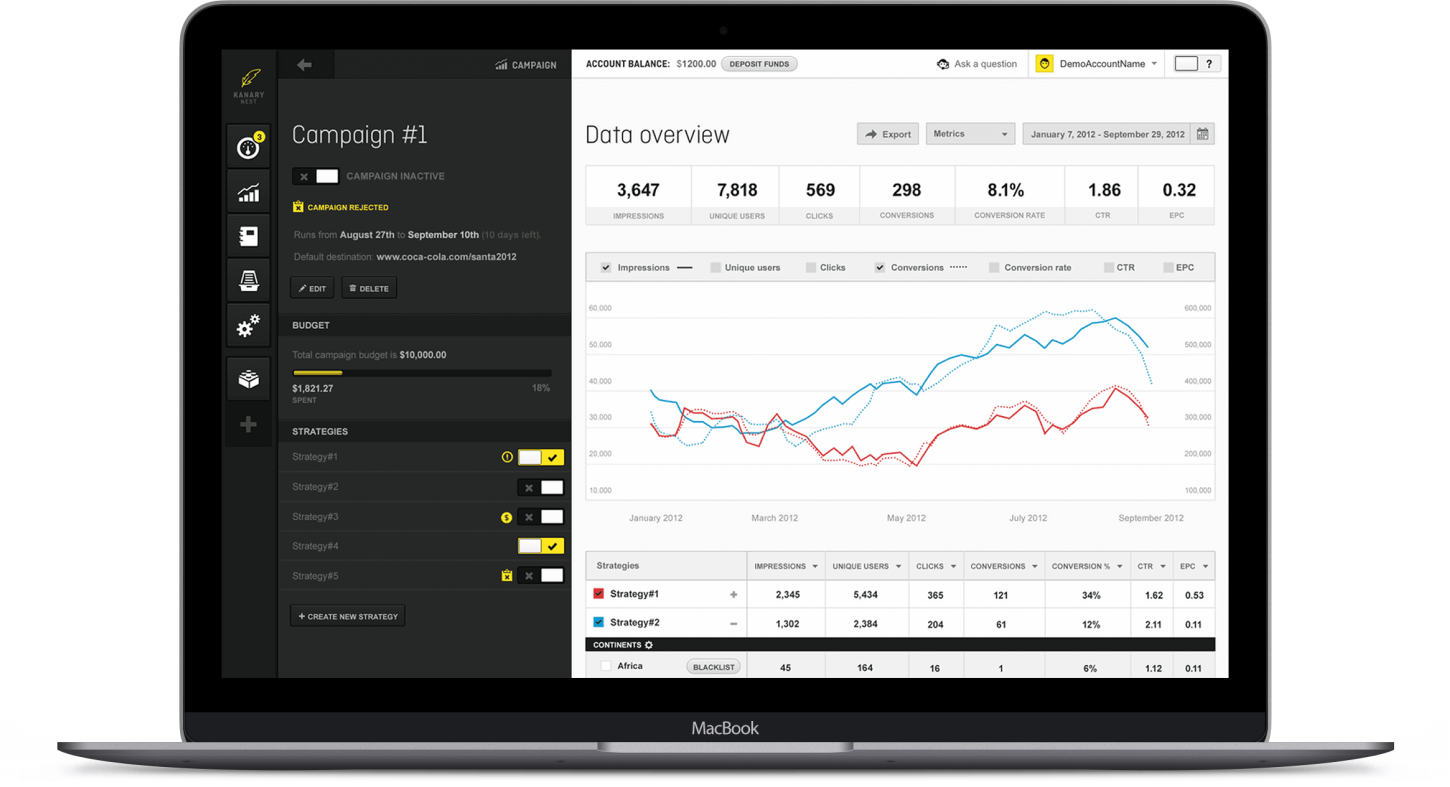
The frontend part of the application provides clients with a unique user experience that has not yet been seen in advertising technology solutions. It was built using JavaScript with Knockout JS as the framework to ensure complete usability. The UX&UI design elements emit a recognizable brand image and deliver a simplistic user experience to what is otherwise a highly complex technology.
Integration
In order to provide marketers with access to the major biddable display advertising inventories, we integrated Kanary with AppNexus and ad exchanges supporting OpenRTB protocols, such as Nexage.
Our development process
- One of the first main tasks we undertook on this project was optimising the backend and database. We redesigned the database structure to enable it to operate more effectively and to increase the process speed of the requests sent from the merchants’ sites.
- Our expertise in this field and our experience with similar projects enabled us to minimise the learning curve and reduce the time spent on planning the project. This allowed us to start developing the application straightaway and maintain a fast pace throughout the development process.
- We used mongoDB for the application’s database, which provides the stability, reliability and performance needed to support the many functions and user requests.
The technologies we used

TypeScript

JavaScript

Pyton

React

NodeJS

GO

Angular
The result
We built the project from the ground up and launched the MVP to private beta testers. Based on the feedback received by the initial users, we made improvements and continued to develop the platform. The platform was featured in the TechCrunch Disrupt 2013 conference in New York and received a lot of positive feedback from attendees.
In August 2014, Kanary NEST was successfully acquired by the online advertising giant, Gravity4.
New clients
+350
Finances
up over 75%
Team Members